A warm welcome to bluebird holistic Health & wellbeing
Psychosocial Resilience: The Role of Belonging in Recovery
We like to think recovery is something we think our way through alone. But resilience is whom we know, not just who we are. Human beings cannot recover without love, attachment, and belonging. Belonging isn't the reward for healing... it's the mechanism. If that's true, how should we be shaping policy and therapeutic services to place belonging and connection at the centre of recovery?
Bianca de Verteuil
8/25/20254 min read
A prevailing social narrative frames recovery as a solitary intellectual pursuit. Pop-psychology suggests that if we work hard enough, we can think our way out of trauma and rebuild ourselves through individual effort alone.
However, emerging science suggests that recovery is built through a complex constellation of narrative building: making what was abstract sensical, integrating values into forward thinking, and making room for feelings. And still, the research shows the power of the relationship is greater than the therapeutic methods.
Resilience is whom we know, not just who we are.
Indeed, some of our modern ideas of "resilience" may have formed from erroneous beliefs. In the Victorian and early 20th-century eras, childcare experts like Truby King and John B. Watson championed a cold, detached approach to parenting. Driven by fear-based doctrines, they positioned themselves as the ultimate authorities on child-rearing, dictating that infants follow strict, unyielding routines entirely stripped of flexibility or the soft warmth of responsive nurturance. Disturbingly, the remnants of these austere views persist today in how we treat people who are struggling.
However, the devastating consequences of this philosophy were exposed decades ago. Dr René Spitz observed that infants in orphanages who were deprived of physical comfort failed to thrive; tragically, a third of them perished within two years. Yet, the belief that love and affection were optional remained dominant.
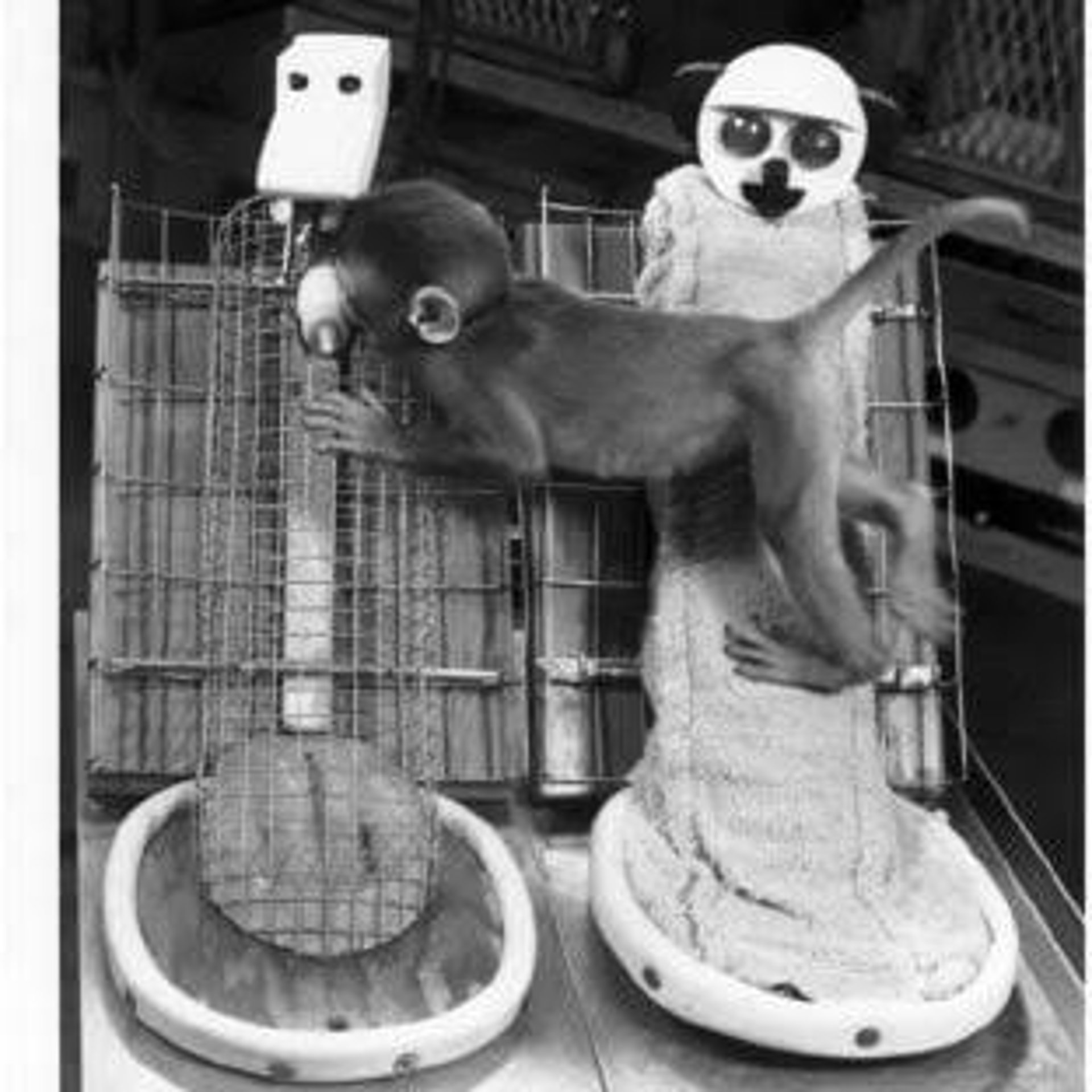
In the 1950s, Harry Harlow set out to decisively dismantle this assumption. Through a series of studies tracking infant monkeys separated from their mothers, Harlow proved that an infant prioritises softness and emotional attachment over raw sustenance.
Given the choice between an inanimate surrogate mother constructed from bare wire that provided a milk bottle, and a soft cloth surrogate that provided none, the monkeys consistently preferred the comforting touch of the cloth mother. They visited the wire surrogate only for a quick feed before rushing back to the safety of the cloth.
Infant rhesus monkey with the two surrogate wire mothers
The truth is simple:
Babies cannot thrive without love, attachment, and belonging.
Mothers cannot thrive without love, attachment, and belonging.
Human beings cannot recover without love, attachment, and belonging.
While we might assume that feeling loved and attached is intuitive, true belonging is routinely misunderstood. As Brené Brown insightfully concluded, fitting in (the act of changing ourselves to be accepted in a social group) is actually the exact opposite of true belonging.
This is grounded in our biology through the Social Baseline Theory developed by James Coan and his colleagues. This framework demonstrates how cognitive processes unfold inherently within a social ecology context. Mammals are hardwired to expect social proximity as a baseline state.
During fMRI neuroimaging studies, Coan et al. (2006) put participants under the threat of a mild electric shock and varied their social environment: alone, with a stranger, or holding the hand of a partner. The brain's emotional-regulation regions worked hardest when a person was alone, less hard with a stranger, and least of all when holding a partner's hand. Attachment doesn't just feel better; it measurably reduces the brain's regulatory load.
Attachment also shapes perception outside the laboratory. In a study where participants were asked to look at a steep hill, those standing next to a close friend perceived the incline as significantly less daunting than those standing alone (Schnall et al., 2008).
Our brains perceive social resources as bioenergetic resources. When we have a suitable social baseline, the body conserves energy by reducing the demands placed on self-regulation. When we navigate hardships in tandem with a trusted community, our load is reduced because we instinctively graft the capabilities of others onto our own neural model of self. A problem shared really is a problem halved, and not just as a figure of speech.
This profound interdependence perhaps sheds light on the devastating destruction wrought by coercive control. By deliberately isolating a victim, an abuser strips away the vital social mirrors of acceptance that are essential for psychological recovery. Survivors are left carrying the full weight of healing alone, without the proximity of a close network that would otherwise step in to share that physiological burden.
The great philosopher Aristotle observed that eudaimonia, or true human flourishing, is the fruit of a well-guarded spirit. The Greek etymology of the word literally translates to eu (good) and daimon (spirit), representing one’s authentic inner self. This flourishing is an emergent property, a state achieved when a person's inner self aligns seamlessly with their outer being.
Simply put, people do not flourish because they are forced, or because they isolate themselves to achieve resilience. Flourishing is a natural state of emergence that occurs only after the fundamental roots of attachment are met. It is within these secure conditions that self-trust, self-efficacy, and true autonomy naturally build, allowing the authentic self to finally step forward.
Recovery was never meant to be a solo project. Belonging isn't the result of healing, it is the fruit of it.
I'd love to hear your opinions on this. Do you agree? And if so, how should we be shaping policy and therapeutic services to place belonging and connection at the centre of recovery?
This is part of a series on coercive control. In the future, I will be looking at the biological mechanism behind isolation, why doesn't just feel harder, but costs the body and brain more energy to manage. Also, looking at recovery and resilience building through the lens of human flourishing research.
With a background in public health (MPH) and psychology (PGDip), I look at trauma and recovery through a systemic lens. Professionally, I work in L&D Insights. I am currently aligning my research towards a public health psychosocial resilience specialism.
Author’s Note: Due to time constraints, AI assistance was used to tidy and format this text for LinkedIn. However, all core concepts, research choices, and arguments are entirely my own original thoughts and synthesis.
References
Aristotle. (2009). The Nicomachean ethics (D. Ross, Trans.; L. Brown, Ed.). Oxford University Press.
Brown, B. (2017). Braving the wilderness: The quest for true belonging and the courage to stand alone. Random House.
Coan, J. A., Schaefer, H. S., & Davidson, R. J. (2006). Lending a hand: Social regulation of the neural response to threat. Psychological Science, 17(12), 1032–1039. https://doi.org/10.1111/j.1467-9280.2006.01832.x
Harlow, H. F. (1958). The nature of love. American Psychologist, 13(12), 673–685. https://doi.org/10.1007/978-1-4614-3967-7_2
Schnall, S., Harber, K. D., Stefanucci, J. K., & Proffitt, D. R. (2008). Social support and the perception of geographical slant. Journal of Experimental Social Psychology, 44(5), 1246–1255. https://doi.org/10.1016/j.jesp.2008.04.011
Spitz, R. A. (1945). Hospitalism: An inquiry into the genesis of psychiatric conditions in early childhood. The Psychoanalytic Study of the Child, 1(1), 53–74. https://doi.org/10.1080/00797308.1945.11823126
#PublicHealth
#TraumaInformedCare
#AttachmentTheory
#MentalHealth
#HealthPolicy